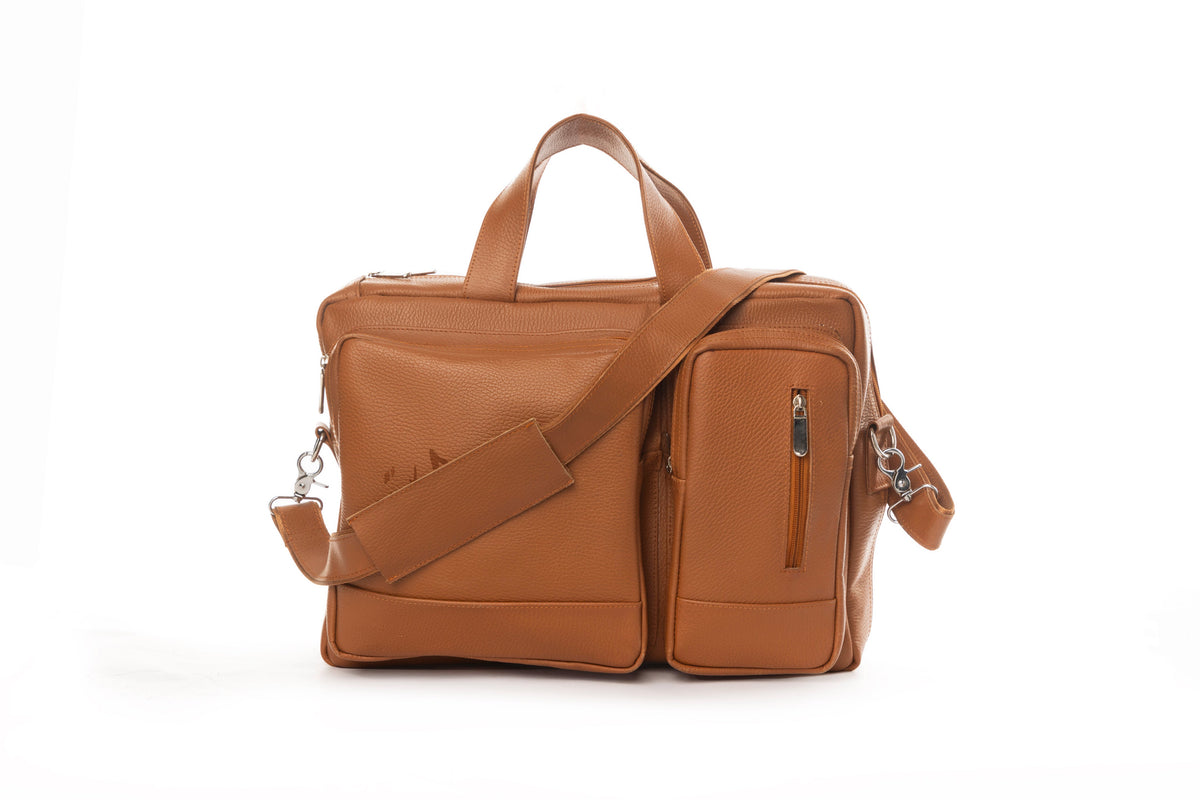
A full-grain leather bag is the only thing you will buy this year that is designed to look better in five years than it does today. That only happens if you do three small things and avoid three big ones. The whole routine takes about fifteen minutes, twice a year.
A dry cloth over the whole bag. That is it. Dust is abrasive — it works into the grain and into the stitching and acts like very fine sandpaper every time the leather flexes. Thirty seconds with a cloth removes it.
Clean first. A cloth barely damp with water, wrung out until it is not dripping. Wipe the whole bag, including the base and the strap. If there is real grime, use a leather cleaner rather than soap — household detergent strips the oils you are about to replace. Let it dry completely, away from heat.
Then condition. A small amount of leather conditioner or cream on a soft cloth, worked in with small circles, one panel at a time. Less than you think — a coin-sized amount does a whole side. Leave it twenty minutes, then buff with a clean dry cloth.
Conditioning replaces the oils that leave the hide over time. Without them the fibres dry, stiffen, and eventually crack, and a crack in leather does not heal. Twice a year is enough for a bag in normal use; three or four times if you are somewhere very dry or very air-conditioned.
Store it stuffed lightly with paper or a cloth so it keeps its shape, somewhere with air movement. Never in a plastic bag — leather is a skin, it needs to exchange moisture, and sealed plastic in a humid climate grows mould on it within weeks. A cotton dust bag is ideal.
Rain is not an emergency. Blot the water off with a dry cloth, do not rub. Stand the bag somewhere with air moving and let it dry at room temperature, which may take a day.
Do not use a hairdryer, a heater or direct sun. Fast heat drives the moisture out along with the oils and the leather shrinks unevenly — that is what creates the hard, wrinkled patches you see on old bags. Once it is dry, condition the area that got wet, because the water took oil with it on the way out.
If it gets properly soaked, dry it slowly and stuff it while it dries so it keeps its shape.
A fresh scratch on full-grain leather is usually just displaced fibres, not removed ones. Rub it firmly with a clean finger — the warmth and the oil from your skin will often close it entirely. If it does not, a little conditioner worked into the mark will darken it back to match.
The deeper point: the marks are the feature. A patina is an accumulation of small events — where your hand rests, where the strap folds, where the corner met a doorframe. It is the reason a leather bag looks like yours and a coated one looks like everyone else's. Trying to keep it factory-new is working against the material.
Wipe zips and buckles with a dry cloth when you clean the leather. If a zip gets stiff, run a graphite pencil along the teeth — not oil, which attracts grit and makes it worse. Stainless steel hardware will not rust, which is worth knowing in a humid coastal climate; plated hardware eventually will, and there is no fix once it starts.
All of the above applies to the Premium range, which is full-grain leather with stainless steel fittings. If your bag is from the Classic or Value Picks ranges, the routine is far simpler: a damp cloth, and never a heat source. Coated and woven materials do not need conditioning and do not benefit from it.